
The Beekeeper’s Raft
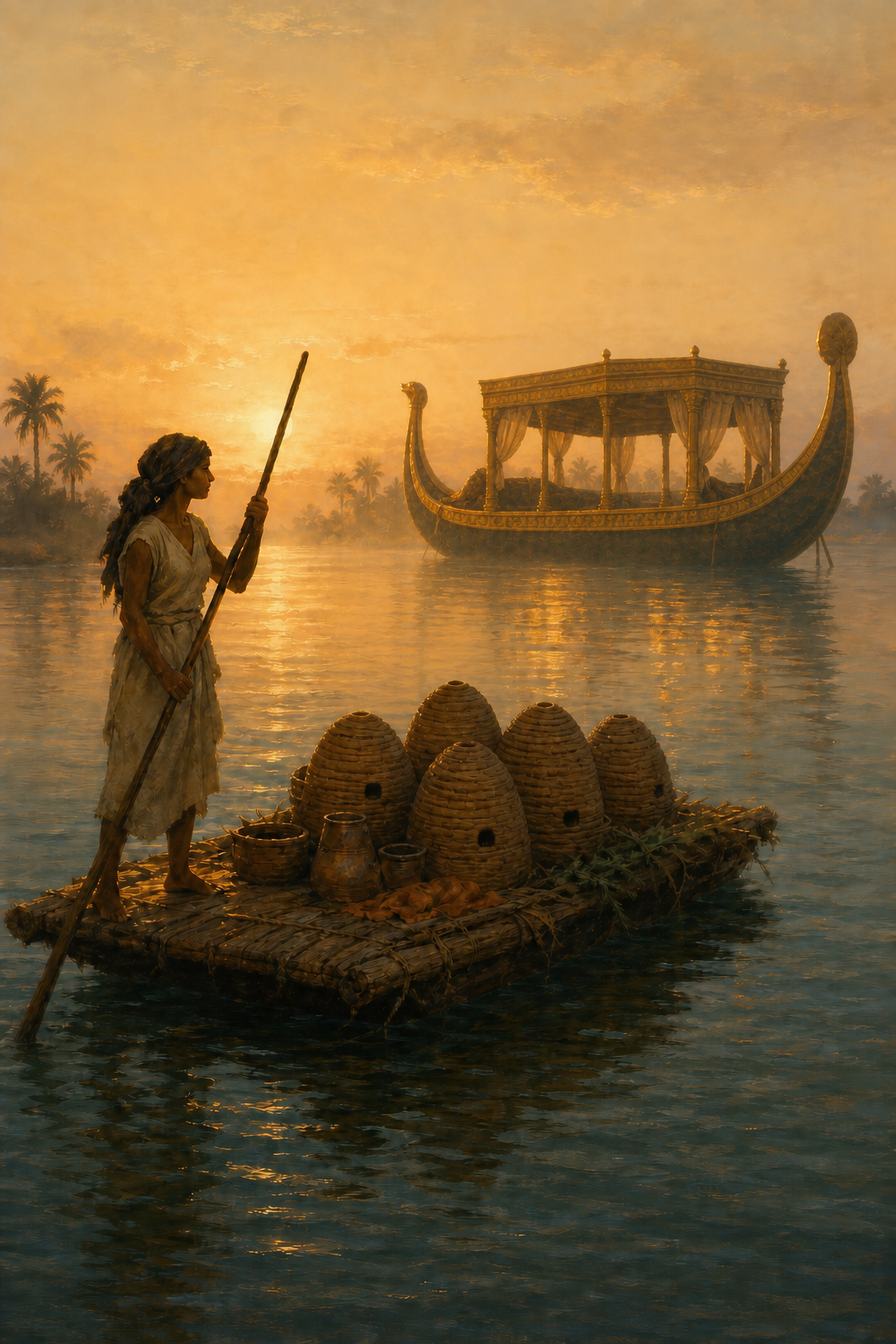
Stories inspired by Egypt’s long love affair with food. The history in the footnote is real.
Merit was nineteen the year she first took the hives downriver alone.
Her family had done it the same way for longer than anyone could count: when the clover began to bloom in the north, you lashed the hives to the raft, pushed off into the current, and followed the flowers. The river did the carrying. The bees did the work. A beekeeper’s job, her grandmother always said, was mostly to be patient somewhere useful.
She travelled in the dark hours, when the bees slept and the water was quiet, and moored before dawn wherever the banks showed green. That morning the mist sat low and the world was the colour of unpolished silver, and Merit was easing the raft toward a stand of clover when she saw the barge.
It stood at anchor in mid-river like something the night had forgotten to take with it — vast, dark-hulled, its gilding holding the first of the light. No banners at that hour. No music. Just a ship the size of a rumour, and around it, the river pretending to mind its own business.
Merit knew what it was. Everyone on the river knew. She kept her eyes down and her pole moving, which is why she did not see the swimmer until the voice came out of the water beside her.
“Your cargo is humming.”
A woman was treading water an arm’s length from the raft — dark hair slicked back, entirely unbothered, as though the Nile at dawn belonged to her. Behind her, distantly, figures on the barge had gone very still and very alert. The woman ignored them. She was looking at the hives.
“They wake with the sun,” Merit managed. “We’re chasing the clover bloom. The flowers open, the bees follow, the raft follows the bees.”
“The raft follows the bees,” the woman repeated, as if testing whether the sentence would hold her weight. “And what do the bees pay you for the ride?”
Merit reached into the basket at her feet and held out the jar — the first of the season, raw and cloudy-gold, still smelling faintly of the field it came from. The woman swam closer, took it in both hands, and ate from it with one finger, there in the water, with the unhurried attention of someone for whom every taster, somewhere, was holding their breath.
For a long moment she said nothing. The mist moved. The bees began, very quietly, to wake.
“In the palace they bring me honey from everywhere,” she said at last. “For my table. For my physicians. For my baths, even — they swear by it.”
She looked up at Merit, and there was something younger in her face than there had been a moment before.
“This tastes of somewhere.”
She ate a little more. Merit, not knowing the etiquette for any of this, ate some too, straight from the comb she kept for herself. And for the space of a few minutes there were just two people on the river eating honey while the sun came up — one of them the most famous woman in the world, the other the only one of the two who knew how the honey was made.
When the voices from the barge grew insistent, the woman handed back the jar — lighter now — and pushed off into open water. A few strokes out she turned.
“Which fields?” she called.
“Wherever the clover is,” said Merit. “That’s the whole secret.”
The queen laughed — a real one, short and surprised — and swam back toward her waiting ship. Merit poled on north after the bloom, and told almost no one, ever, which is why you have not heard this story before.
Some mornings, the river is just a river. And some mornings it carries a raft full of sleeping bees, a jar of the season’s first honey, and a queen who learned before breakfast what every beekeeper already knows: the best honey tastes of the place it came from.
The true history behind this tale
The raft is real. Egyptian beekeepers were moving their hives along the Nile to follow the blooms thousands of years ago — among the earliest migratory beekeeping anywhere on earth — and beekeeping itself appears in Egyptian temple reliefs more than four thousand years old, when honey served as offering, medicine and payment. Cleopatra’s devotion to milk-and-honey baths is the stuff of ancient legend. And the beekeeper’s secret hasn’t changed in two thousand years: honey tastes of wherever the bees went — which is the whole story of Boosh the Beekeeper’s clover fields, told properly here in The Clover Fields.