
Egyptian Medjool Dates vs. Saudi Arabia, Jordan & the USA: What Actually Sets Them Apart
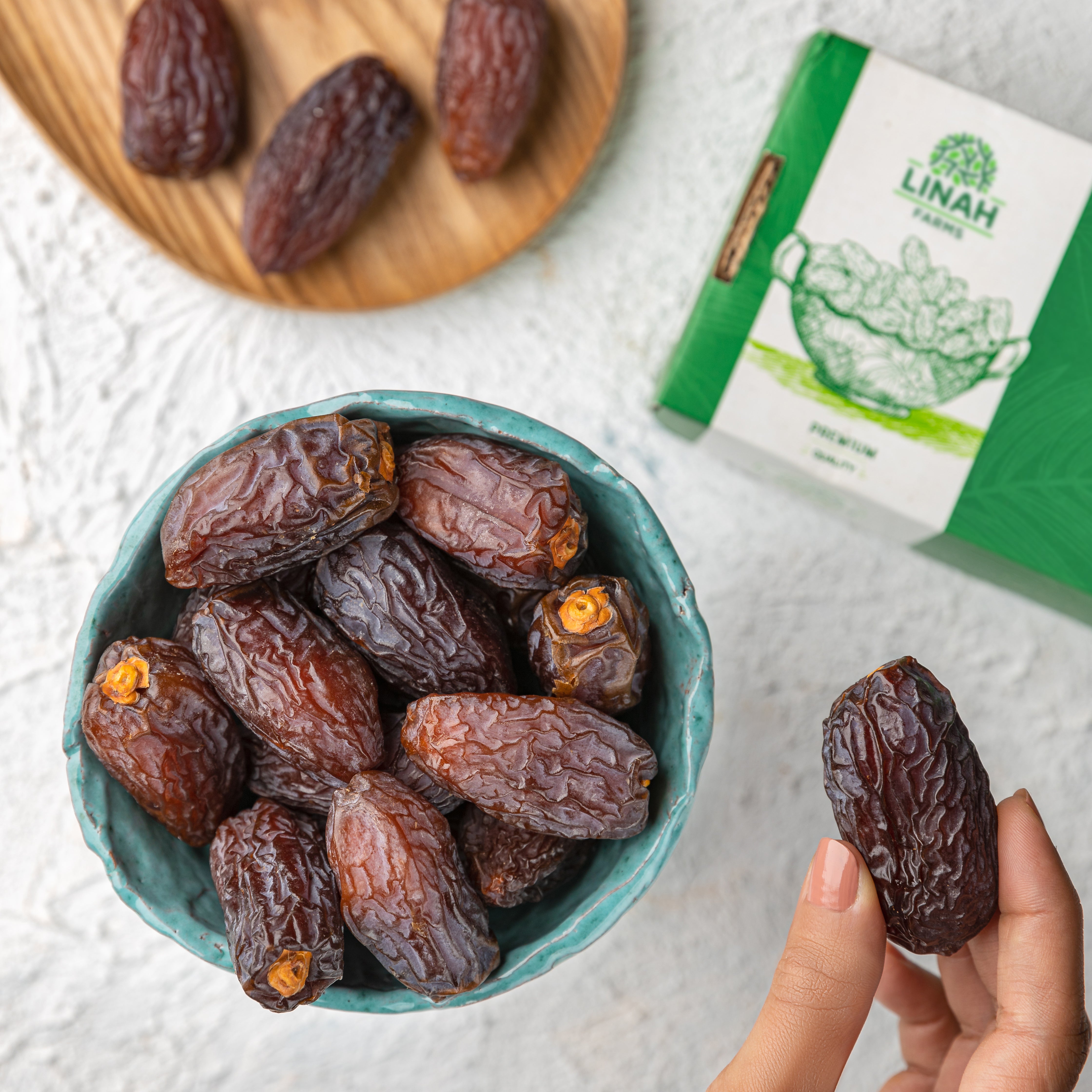
Egyptian Medjool dates, grown in the oases of the Western Desert, are set apart from Saudi, Jordanian and Californian Medjools by desert terroir — intense dry heat and aquifer-fed irrigation that concentrate the sugars into a deeper, more caramel-forward flavour. The cultivar is the same everywhere; where it ripens is what changes the taste.
Medjool dates gets called the “king of dates.” But not all Medjools are the same. The variety is identical — one cultivar that travelled the world from its origins in Morocco. Where it’s grown is what changes everything: the climate it ripens in, the soil under it, how it’s harvested, and the taste that ends up in your hand. Here’s how Egypt stacks up against the three origins you’re most likely to meet — and why, by the end, it takes the crown.
First, a quick myth-buster
“Medjool” is the cultivar, not the country. A Medjool from Egypt and a Medjool from California are the same palm, genetically. What differs is terroir — the same way Chardonnay from Burgundy tastes nothing like Chardonnay from Australia. Growing conditions, water, harvest timing, how the fruit’s handled afterward: that’s where the differences below come from.
Egypt — the winner
Egypt is the world’s largest date producer by volume. The Medjools grown in the Western Desert oases — places like the Bahareya Oasis — ripen under intense, dry desert heat, irrigated from deep aquifers. You get a date with deep caramel character, flesh that’s soft but not mushy, and a clean finish.
A few things line up in Egypt’s favour that are hard to find anywhere else:
- The oldest date-growing culture on earth. Egyptians have farmed date palms for more than 5,000 years. That’s not a marketing flourish. It’s generations of knowing when to pollinate, when to harvest, how to handle the fruit — concentrated in regions that have done little else for millennia.
- Desert terroir that intensifies flavour. The Western Desert oases sit in some of the driest, hottest growing conditions on the planet. Low humidity means less disease pressure and slower, more even ripening, which concentrates the sugars and builds that caramel depth instead of flat, one-note sweetness. Aquifer-fed irrigation hands growers precise control over water — a luxury a lot of regions don’t have.
- The flavour itself. Most origins give you sweetness. A well-grown Egyptian Medjool gives you complexity — caramel, a faint toffee note, a clean finish that doesn’t cloy. Sugar versus butterscotch.
- A date grown for the people who know it best. Egypt’s harvest has fed Egypt for generations — more than 120 million people who grew up on dates and know exactly what a good one tastes like. The fruit’s been grown to satisfy the most demanding everyday audience there is, not a distant export buyer. Bringing these dates abroad is recent: the rest of the world has eaten Medjools from California and Jordan for decades, and Egyptian Medjools are only arriving now — the same quality Egyptians mostly kept for themselves.
The one variable to watch isn’t the fruit. It’s the grower and the handling. A carefully farmed, hand-graded Egyptian Medjool competes with anything on earth; a bulk-bin one won’t. Sourcing matters more here than with any other origin — which is exactly why the producer is everything.
Flavour rating: 5 / 5
Flavour profile: Rich, caramel-forward, complex, soft, clean finish.
Best for: Eating out of hand, premium gifting, anyone chasing top-tier flavour and depth.
Saudi Arabia
Saudi Arabia is one of the historical homes of date culture — though its signature varieties are Ajwa, Sukkari, and Khalas, not Medjool. Where Saudi growers do produce Medjool, the hot Gulf climate gives you a sweet, dense date.
The Saudi date reputation is enormous, and a lot of it attaches to varieties other than Medjool. If someone’s selling “Saudi Medjool,” ask where specifically it was grown — the Kingdom’s fame rests mostly on its native cultivars.
Flavour rating: 3.5 / 5 (for Medjool specifically; the native Saudi varieties are a different — and excellent — story)
Flavour profile: Very sweet, dense; though the Saudi headline varieties (Ajwa, Sukkari) are different fruits altogether.
Best for: Buyers specifically chasing the Saudi date heritage — but check whether you’re getting Medjool or a regional variety.
Jordan
Jordan punches well above its size in premium Medjool. The Jordan Valley — especially the areas around the Dead Sea, the lowest place on earth — has a microclimate all its own: very low elevation, high temperatures, mineral-rich conditions. Jordanian Medjools have built a strong export reputation on large, glossy fruit and consistent grading.
Flavour rating: 4.5 / 5
Flavour profile: Large, sweet, glossy, consistent; less of the deep-caramel note than Egypt, more straightforward sweetness.
Best for: Buyers who want a reliably graded, large, sweet date.
USA (California)
Medjool reached the United States in the 1920s, when a handful of offshoots were rescued from disease in Morocco and replanted in California’s Coachella Valley, then Arizona. American Medjools run very large, uniform, and meticulously graded — the product of a highly mechanised, quality-controlled industry. The flavour leans toward big, clean sweetness. Consistency is the headline: you generally know exactly what you’re getting.
Flavour rating: 4 / 5
Flavour profile: Very large, uniform, clean sweetness, slightly less complex.
Best for: Buyers prioritising size, uniformity, and consistency.
Quick comparison
| Origin | Rating | Flavour | Texture | Key strength |
|---|---|---|---|---|
| Egypt | 5 / 5 | Deep caramel, complex | Soft, balanced | Depth and complexity |
| Jordan | 4.5 / 5 | Sweet, glossy | Large, firm | Consistent premium grading |
| USA | 4 / 5 | Clean, big sweetness | Very large, uniform | Uniformity & consistency |
| Saudi Arabia | 3.5 / 5 | Very sweet | Dense | Heritage (often non-Medjool) |
Where to find Egyptian Medjools in Singapore
The case for an Egyptian Medjool is only ever as good as the grower behind it. That’s the whole reason MISRDELIGHTS works with one named farm rather than a region.
At Linah Farms, the dates are left to take their time. Slow-ripened under the generous sun of the Bahareya Oasis — a Western Desert oasis, not a riverside crop — and handpicked when the moment’s right. What you get is a Medjool that’s plump and yielding, with a deep caramel sweetness that comes entirely from the fruit. Deep mahogany skin, dense honeyed flesh, a quiet note of dark toffee on the finish. Nothing added, no shortcuts.
Each harvest is independently lab tested. They reach Singapore straight from the grower — sold here as Egyptian Large Medjool Dates from Linah Farms, exclusive to Singapore through MISRDELIGHTS.
A good Egyptian Medjool rewards a little patience: at room temperature, with black coffee, folded into yoghurt, or torn into a cheeseboard beside aged hard cheese and walnuts.